Papers
Papers
Longer-form technical papers — the full arguments, with citations, before they get broken up into dispatches.
Bounded by Design
The Architecture of Agentic Security and What the Terminology Obscures
Abstract
The cybersecurity industry is presently rebranding established security analytics and workflow automation architectures as "agentic AI," "autonomous SOC," and "self-directed security operations." This paper examines that claim from a systems engineering perspective. The foundational architecture underneath most production systems marketed as agentic security platforms is not new: it is distributed event processing, stateful correlation, graph analytics, deterministic orchestration, bounded tool execution, and probabilistic enrichment. Large Language Models and embedding systems have introduced real operational improvements — reducing analyst burden, compressing investigation time, and improving interface quality — but in most production environments these AI components are inserted into pre-existing distributed security analytics architectures rather than replacing them. The distinction matters because architecture determines failure behavior. A deterministic workflow engine with a probabilistic enrichment layer has different safety, auditability, scaling, and failure characteristics from a truly autonomous cognitive system. This paper decomposes modern agentic security claims into their actual execution primitives, identifies the economic and organizational incentives that sustain the terminology, describes the specific conditions under which the agentic framing would become architecturally accurate, and defines the requirements for safe AI-augmented security operations.
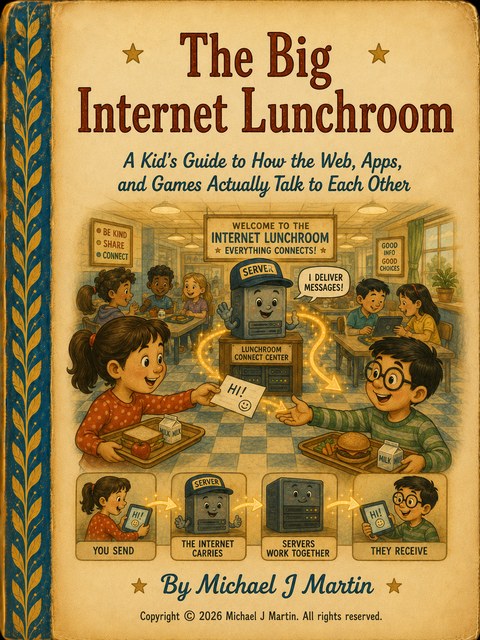
The Big Internet Lunchroom
A Kid's Guide to How the Web, Apps, and Games Actually Talk to Each Other
About the Book
A picture book about how the internet actually works, told through a school lunchroom where a friendly "Server" delivers notes between kids — dressed up as a children's book, but really written for the adults who've spent their careers explaining "the cloud" to people who nod and still don't get it. If you can't explain packet delivery to a room of second graders, you probably don't understand it as well as you think you do.